Fistula Associated With Abscess: Complete Treatment Guide
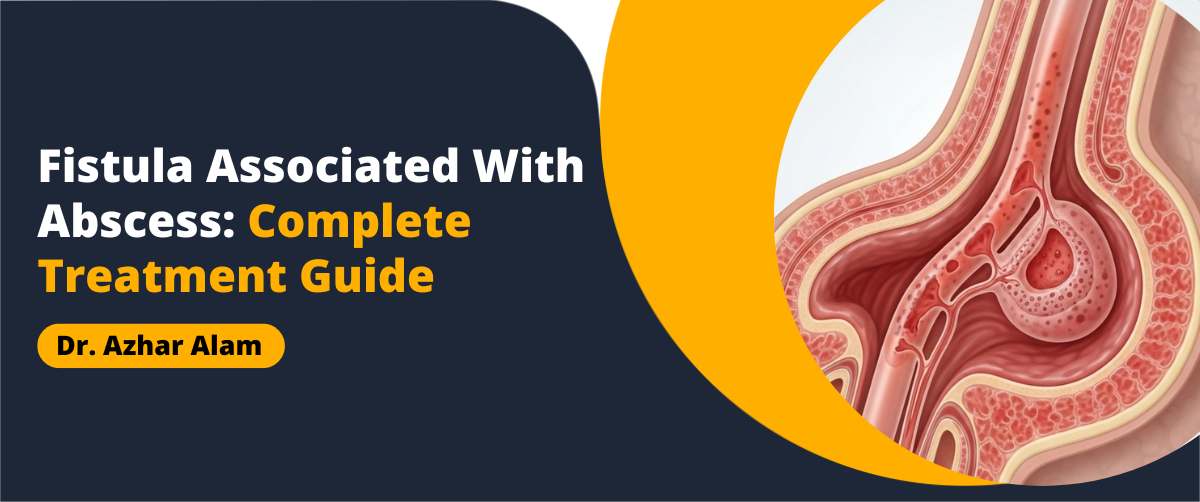
Fistula Associated With Abscess is a common condition that develops after an untreated or poorly healed anorectal abscess. It often causes persistent pain, swelling, and discharge. Early diagnosis and timely treatment help prevent complications and improve recovery. Consulting an experienced Fistula Doctor in Kolkata ensures accurate diagnosis and personalized treatment planning. Many fistulas are cryptoglandular in origin (related to blocked anal glands) and develop after abscess episodes. Recent systematic reviews estimate anal fistula prevalence around ~18 per 100,000 people, underscoring that this is a fairly common colorectal condition. Therefore, early diagnosis and prompt treatment play a vital role in preventing complications.
Also Read: Multiple Tract Fistula: Causes & Treatment Options
Symptoms of Fistula Associated with Abscess
Typically, patients experience one or more of the following symptoms.
- Recurring painful swelling or lumps near the anus (abscess).
- Persistent drainage of pus, blood, or serous fluid from an external opening.
- Intermittent pain, fever, or difficulty sitting.
If you’ve had an abscess that continues to drain or repeatedly returns, seek medical advice promptly. Consulting an experienced Fistula Specialist in Kolkata helps doctors identify the fistula early and recommend the most appropriate treatment. Therefore, patients should never ignore persistent drainage or recurring pain after an abscess.
Diagnosis Process of Fistula Associated with Abscess
Initially, doctors begin the diagnosis with a clinical examination and a detailed medical history. Imaging, including endoanal ultrasound or MRI of the pelvis, helps map complex tracts and detect secondary branches. MRI remains the gold standard for evaluating complex fistulas. Consulting an experienced Fistula Doctor in Kolkata ensures that patients receive accurate imaging and an appropriate treatment plan based on the fistula’s anatomy. Clinical guidelines also recommend early incision and drainage for abscesses, followed by targeted imaging when doctors suspect a fistula. Fortunately, several effective treatment options are now available. Moreover, doctors select the most suitable treatment according to the fistula’s complexity, location, and overall health of the patient.
Choosing the correct treatment at an early stage significantly improves the chances of complete healing and lowers the risk of recurrence. Doctors carefully evaluate whether the fistula is simple or complex before recommending surgery or minimally invasive procedures. They also consider factors such as previous infections, diabetes, prior operations, and sphincter involvement to protect normal bowel function. Additionally, regular follow-up appointments allow doctors to monitor healing and identify complications before they become serious. Patients should always follow postoperative instructions, maintain proper hygiene, eat a fiber-rich diet, and avoid constipation to support recovery. Early diagnosis, appropriate imaging, and individualized treatment planning together provide the best opportunity for successful long-term outcomes while preserving continence and improving quality of life.
Treatment Options of Fistula Associated with Abscess
Today, fistula laser treatment in Kolkata offers a minimally invasive option for many patients with suitable fistulas. Compared with conventional surgery, laser treatment usually causes less pain, minimal bleeding, and a quicker recovery. However, your surgeon will recommend the best approach after evaluating the fistula’s complexity.
Incision & drainage (I&D) — immediate, essential for abscesses to prevent sepsis; often the first step.
Fistulotomy / fistulectomy — standard for simple, low fistulas (good healing rates but not suitable for high or complex tracts).
Sphincter-sparing techniques — LIFT, seton placement, plugs, advancement flaps — chosen to reduce incontinence risk in complex fistulas. Recurrence rates vary widely depending on technique and fistula complexity (literature reports recurrence from single-digit to >25% in complex cases).
Minimally invasive laser procedures (FiLaC / fistula-tract laser closure) —
are increasingly used because they offer favorable recovery, shorter hospital stays, and acceptable healing rates. Primary healing rates are commonly reported between 60–80%, depending on the study and follow-up period. Recent randomized and cohort studies (2024–2025) also demonstrate promising safety and patient-centered outcomes compared with open surgery for selected patients. Today, fistula laser treatment in Kolkata provides a minimally invasive option for suitable patients seeking faster recovery and less postoperative discomfort.
Selection of Right Treatment
Selecting the best treatment depends on the fistula’s complexity, sphincter involvement, and the patient’s overall health. Consulting an experienced Fistula Doctor in Kolkata helps patients understand all available treatment options, including laser procedures and sphincter-preserving surgery. Clinics offering MRI mapping, sphincter-sparing options, and transparent recurrence statistics are preferable. Recent expansion of laser proctology services in Kolkata (government and private centers) means more local options for minimally invasive care. Finally, understanding the expected recovery and recurrence rates helps patients make informed treatment decisions.
Outcomes for Treatment
Healing and recurrence depend on fistula complexity: simple fistulas have low recurrence; complex fistulas may recur in a higher percentage. Studies report up to ~25%+ for complex cases. Newer techniques like laser closure show good safety profiles. Some studies report primary healing ~60–70% with low complication rates, but longer follow-up is still maturing.
If you’ve had an anorectal abscess, persistent drainage, or recurrent pain — consult a colorectal/fistula specialist promptly. For patients in Kolkata seeking expert care, consult a reputed colorectal team and compare credentials, imaging availability, and outcomes. If you’re exploring trusted names, many patients in the region search for a best fistula doctor in Kolkata or Dr. Azhar Alam as part of their decision-making. Early diagnosis, accurate mapping (MRI), and a tailored operative plan provide the best chance for cure with minimal functional loss. Discuss sphincter-sparing options, laser closure, and recurrence statistics with your surgeon to choose the best fistula treatment in Kolkata for your case.