
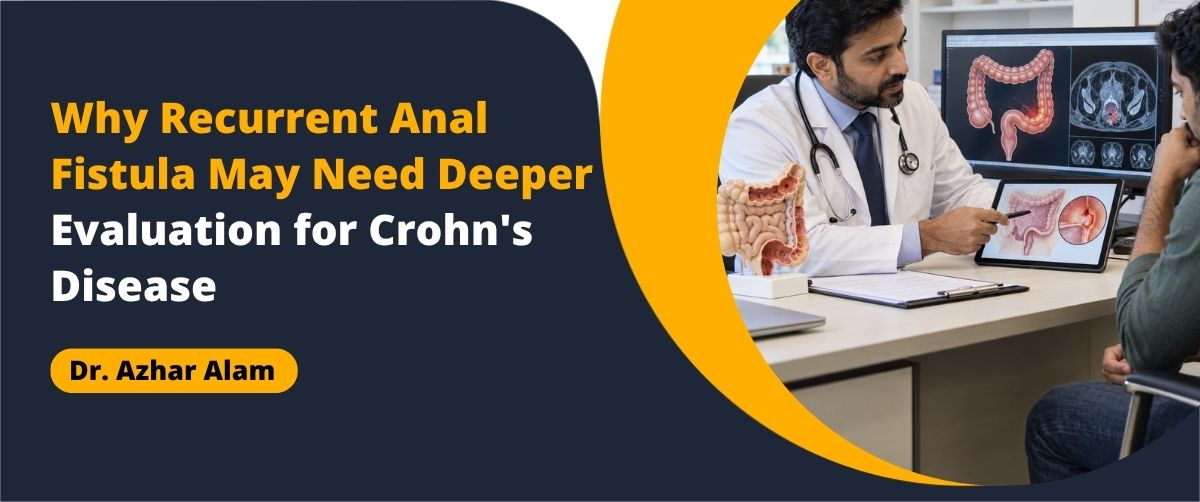
Why Recurrent Anal Fistula May Need Deeper Evaluation for Crohn’s Disease
A Recurrent Anal Fistula can be frustrating when drainage, swelling, or pain returns after previous treatment. Many anal fistulas develop from infected anal glands and have no connection with Crohn’s disease. However, repeated or unusually complex fistulas can sometimes prompt doctors to investigate an underlying inflammatory bowel condition. A Fistula doctor in Kolkata can assess the fistula pattern and decide whether further tests are necessary.
Recurrent Anal Fistula: Why Doctors Look Beyond the Tract
A fistula may return when an internal opening remains active, a secondary branch goes unnoticed, or another abscess develops. Scar tissue from previous procedures can also make the anatomy harder to assess. For this reason, recurrence does not automatically point to Crohn’s disease. A Fistula specialist doctor in Kolkata may look more deeply when fistulas keep returning or show unusual features. The aim is to understand why healing has not lasted instead of simply treating each new episode as an isolated problem.
Read More: Fistula After Perianal Abscess: When Should a Small Opening Be Checked?
What Can Make a Fistula Recur?
Several factors can contribute to recurrence. A hidden side tract, an undrained abscess, a missed internal opening, or complex anatomy may prevent complete healing. Some fistulas also pass through significant portions of the anal sphincter muscles, which makes treatment planning more challenging. A Fistula doctor in Kolkata can review previous procedures, imaging reports, symptoms, and the location of the current openings. This information helps determine whether recurrence relates mainly to fistula anatomy or whether another medical condition deserves investigation.
Recurrent Anal Fistula: When Crohn’s Disease Enters the Discussion
Crohn’s disease causes chronic inflammation in the digestive tract. In some people, perianal problems such as abscesses or fistulas may appear before obvious intestinal symptoms. However, most people with an anal fistula do not have Crohn’s disease. Patients searching for the best Fistula Treatment Kolkata should therefore focus first on an accurate diagnosis. Repeated fistulas, multiple openings, complex branches, or associated bowel symptoms may give the doctor a reason to investigate beyond the fistula itself.
Symptoms That May Suggest Inflammatory Bowel Disease
Doctors may ask about persistent diarrhea, abdominal pain, unexplained weight loss, blood in the stool, fatigue, or repeated urgency to pass stool. They may also ask about mouth ulcers, joint symptoms, skin problems, or a family history of inflammatory bowel disease. A Fistula doctor in Kolkata will consider these symptoms together with the fistula findings. One symptom alone does not confirm Crohn’s disease. The overall clinical picture determines whether additional testing would provide useful information.
Recurrent Anal Fistula: Why MRI May Be Helpful
Pelvic MRI can map the fistula tract and show how it passes through surrounding tissues. It may reveal secondary branches, hidden abscesses, multiple tracts, or inflammation that a surface examination cannot fully show. MRI becomes particularly useful in complex or recurrent cases. Before Laser Fistula Treatment Kolkata, detailed imaging may help the surgeon understand the tract pattern when the anatomy is unclear. MRI cannot diagnose Crohn’s disease by itself, but certain complex fistula features can encourage doctors to investigate for an underlying inflammatory condition.
Recurrent Anal Fistula: Why Bowel Evaluation Matters
When the history or fistula pattern raises concern for Crohn’s disease, the doctor may recommend evaluation of the bowel. This may include consultation with a gastroenterologist and tests that look for inflammation inside the colon or small intestine. A Fistula doctor in Kolkata may work with a gastroenterologist when deeper evaluation becomes necessary. Depending on the individual case, doctors may consider blood tests, stool inflammation tests, ileocolonoscopy, or small-bowel imaging.
How Crohn’s Disease Changes Fistula Treatment
A fistula related to Crohn’s disease may need a different strategy from a typical cryptoglandular fistula. Doctors must control infection while also addressing inflammation in the bowel. Treatment may therefore involve both colorectal surgery and medical therapy. A Fistula surgeon in Kolkata can manage drainage, abscesses, setons, or other surgical needs when appropriate. If Crohn’s disease contributes to the fistula, a gastroenterologist may also recommend medicines that control the underlying inflammatory disease.
Recurrent Anal Fistula: Why Surgery Alone May Not Be Enough
Repeatedly operating on a fistula without understanding its cause may not solve the problem when active Crohn’s disease drives ongoing inflammation. The medical team must also consider sphincter preservation because repeated procedures can affect surrounding tissues. Patients considering Laser Fistula Treatment Kolkata should first undergo a complete evaluation to identify hidden anatomy, persistent infection, Crohn’s disease, or other factors. This broader assessment can help the medical team choose a more appropriate treatment plan.
Recurrent Anal Fistula: What a Deeper Evaluation May Include
A deeper evaluation starts with medical history and examination. The doctor may ask when the first abscess appeared, how often the fistula has returned, which procedures you have already undergone, and whether bowel symptoms occur between flare-ups. A qualified laser surgeon in Kolkata may also review MRI findings before deciding whether laser treatment fits the fistula anatomy. A laser procedure may suit selected cases, but recurrent or Crohn’s-related fistulas often require a broader treatment strategy rather than one procedure alone.
Doctors may also examine the rectum and colon when Crohn’s disease seems possible. Current diagnostic guidance supports ileocolonoscopy and small-bowel imaging when a patient’s history or fistula characteristics suggest inflammatory bowel disease. A Fistula specialist doctor in Kolkata may recommend a gastroenterology assessment when recurrent disease appears alongside digestive symptoms or complex imaging findings. Coordinated care can help treat both the fistula and any underlying bowel inflammation.
When Should You Seek Medical Advice?
Seek medical care if fistula drainage repeatedly returns, new openings appear, swelling keeps developing, or pain becomes worse. Fever, increasing redness, or severe tenderness may indicate another abscess and needs prompt assessment. Do not assume that recurrence always means the previous procedure failed. Fistula anatomy can change, secondary tracts may become visible later, and underlying inflammation can influence healing.
Recurrent Anal Fistula: Final Thoughts
A Recurrent Anal Fistula does not automatically mean that you have Crohn’s disease. Most anal fistulas arise from causes unrelated to inflammatory bowel disease. However, repeated recurrence, complex tracts, multiple openings, bowel symptoms, or certain imaging findings may justify deeper investigation. A Fistula doctor in Kolkata can evaluate these clues and decide whether MRI, bowel tests, gastroenterology review, or another assessment should form part of your treatment plan.