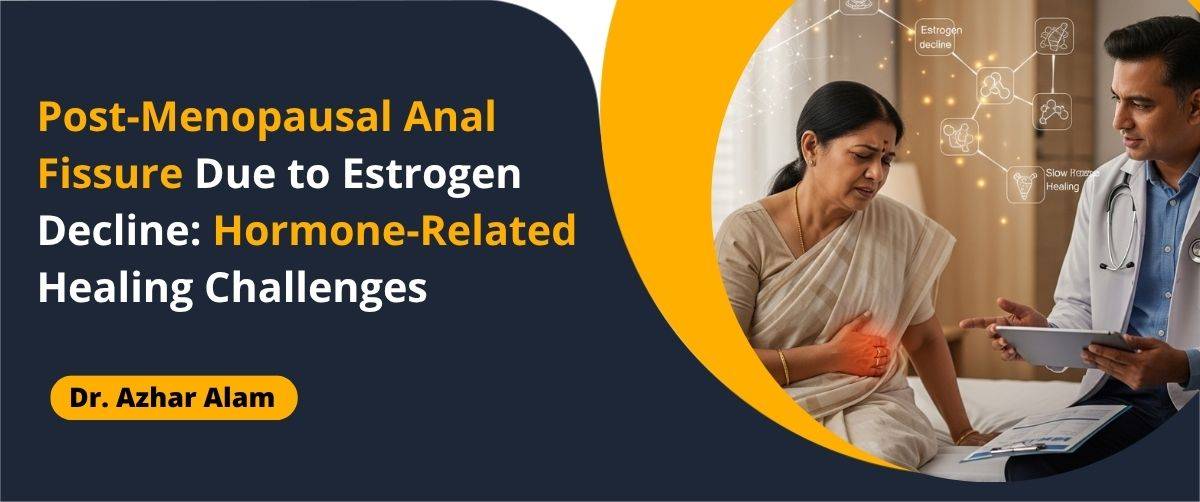
Post-Menopausal Anal Fissure Due to Estrogen Decline: Hormone-Related Healing Challenges
Post-menopausal anal fissure is a painful condition that can cause burning, dryness, bleeding, and discomfort after menopause.
Menopause affects several body functions, including tissue repair, moisture balance, and blood circulation. These hormonal changes can weaken anal tissues and slow down the natural healing process.
This blog explains why post-menopausal women may develop anal fissures even without severe constipation or straining. It also highlights how reduced estrogen levels contribute to pain, delayed healing, and recurring symptoms.
Dr. Azhar Alam, a leading fissure doctor in Kolkata, provides specialised evaluation and advanced treatment for women experiencing persistent fissure symptoms after menopause.
ALSO READ: Post-Delivery Anal Fissure: Causes & Recovery
What Oestrogen Does for Your Tissue — And What Happens When It Drops
Estrogen supports tissue repair, moisture balance, and elasticity throughout the body, including the anal canal.
After menopause, estrogen levels decline significantly. As a result, anal tissues become thinner, drier, and less flexible. Reduced moisture and elasticity make the anal lining more vulnerable to tears and irritation.
Even normal bowel movements can create enough friction to cause a painful anal fissure in post-menopausal women.
Dr. Azhar Alam, a leading fissure doctor in Kolkata, explains that many women develop fissures without severe constipation or excessive straining. In many cases, weakened tissue caused by low estrogen levels becomes the primary reason for injury and delayed healing.
Why Post-Menopausal Fissures Are Harder to Heal
Many acute anal fissures heal naturally within a few weeks. Proper diet, hydration, and basic care often help younger patients recover faster.
In post-menopausal women, healing becomes slower because hormonal changes affect tissue repair and blood circulation.
Reduced tissue regeneration — Estrogen helps repair damaged anal tissues. Lower estrogen levels reduce the body’s natural healing ability.
Decreased blood supply — Menopause can reduce blood circulation in the pelvic region. Poor circulation limits oxygen and nutrients needed for healing.
Dry and fragile tissue — Anal tissues become thinner and less elastic after menopause. Even mild constipation or bowel pressure can reopen the fissure. This may eventually require professional fissure treatment in Kolkata.
Increased sphincter tension — Hormonal changes can tighten the anal sphincter muscles. Increased tension reduces blood flow further and delays healing.
Symptoms Post-Menopausal Women Should Watch For
The majority of women who experience menopausal symptoms link their anal pain and discomfort to haemorrhoids and pelvic changes and age-related problems, while they remain unaware of the possibility of a fissure. The following signs should be observed, and you should consult the best fissure doctor in Kolkata if the symptoms continue for more than one week.
- Sharp, intense pain during and immediately after a bowel movement
- A burning sensation that lasts anywhere from minutes to hours after passing stool
- Small streaks of bright red blood on toilet paper or in the bowl
- A visible small tear or crack near the anal opening
- Fear or avoidance of bowel movements due to anticipated pain
- Persistent itching or soreness around the anal area
How Post-Menopausal Anal Fissure Is Treated
Dr. Azhar Alam, a Fissure specialist doctor in Kolkata, for post-menopausal women with the following considerations in mind:
Stool softeners and fibre supplementation — Soft stool maintenance throughout bowel movements provides maximum protection against anal tissue damage, which already suffers from fragility, thereby offering the best conditions for fissure recovery.
Topical treatments — Oestrogen-based topical creams applied locally can significantly improve tissue moisture, elasticity, and blood supply to the anal mucosa, which directly treats the hormonal source of fissures.
Nitroglycerin or calcium channel blocker ointments —These treatments relax the internal anal sphincter muscles while they enhance blood circulation to the fissure area, and they decrease discomfort during bowel movements, which makes them especially suitable for post-menopausal women who experience higher sphincter muscle tension.
Surgical intervention when conservative measures fail — The medical team will decide to perform a minor surgical procedure when treatment through topical solutions and dietary changes fails to treat a persistent fissure. The current surgical methods of today offer patients their least invasive option, which delivers superior accuracy and requires shorter recovery times.
You Do Not Have to Live with Post-Menopausal Anal Fissure Pain
The medical condition exists because its cause is known and its treatment is available.
Dr. Azhar Alam, the best fissure doctor in Kolkata, treats post-menopausal women by using his medical expertise to understand their specific healing challenges, which he handles with full dedication to every situation.
You should end your silent suffering because you need to start your process of recovery.
Dr. Azhar Alam, a Fissure specialist doctor in Kolkata, provides both compassionate assessments and modern anal fissure treatment in Kolkata, which he developed specifically for post-menopausal women.